Residential License # 890459
Commercial License # 3667
Claim Your FREE Estimates Today!
Talk to an Expert
Residential License # 890459
Commercial License # 3667
Talk to an Expert

Outdoor kitchens can be made very long-lasting, very functional, and extremely good-looking with the proper materials and good planning. In warmer climates like the South, granite, concrete, and stainless steel become brilliant choices.
Strong, little maintenance, and capable of slicing and dicing with heat changes, grilling, and entertaining use, they make great candidates. Perfect countertop choices add functionality as well as beauty to the outdoor living space.
For a reliable countertop, you can count on us at TurnKey Patio. Ready to start building the outdoor kitchen you’ve been imagining? Get in touch with us today, and let’s create a space you’ll enjoy for years.
There are a ton of things to consider before making a good choice about outdoor counter surfaces. Each material should withstand the outdoor elements, make up for practicality and style, and at the same time, be reasonable in terms of cost.
Now, about durability and weather resistance, when it comes to outdoor counters, they have to be durable because they are exposed to the elements all the time. Maximum UV rays, inflow, and freeze-thaw cycles suffice in creating havoc, deterioration, or damage to hardscaping and materials collectively over the years.
Granite and quartzite are the premier natural stone selections; they can even withstand ultraviolet (UV) exposure and high temperatures. Concrete is more economical, but the ability to resist the same nasty conditions is conferred by proper sealing and maintenance on it.
Selecting a material based on your desired maintenance is critical. Like granite and concrete, they require resealing often to maintain stain resistance. Otherwise, go with stainless steel, which is low in combination with high maintenance and cleaning.
Homeowners must be aware of how much time they are willing to spend on maintenance compared with the advantages coming from the material after long periods.
When it comes to climates, it usually tends to be a major determinant of how materials perform. For instance, in the humid or coastal areas, like the Gulf South, stainless steel is rust-resistant, while tile has moisture problems.
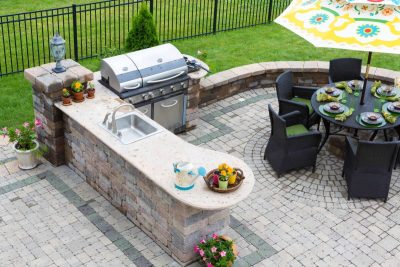
Ensuring that one has selected an appropriate outdoor kitchen countertop involves looking at two sides: aesthetics and functionality. Outdoor countertops are exposed to the elements, come under the heavy torch of sunlight, and are heavily worked upon, making durability and maintenance an essential consideration.
Each material has its own set of pros and cons, helping you find the best fit for your space.
Granite is classy and timeless, a material resistant to heat and UV rays that suits well in sunny areas. It is available in many colors, requires periodic sealing, and can last for several decades with good maintenance.
Another strong contender with low maintenance, quartzite does not allow UV rays to fade its glory and thus fits into sunny outdoor locales. Its shine is the rival of marble, but it is much more resistant to staining and scratching.
Famous for its beauty and ease of maintenance, soapstone is usually considered heat- and stain-resistant, which makes it an attractive option for cooking areas. Scratches may develop over time, imparting a patina to the stone.
Of the most costly options, this smooth stone requires frequent sealing, is more susceptible to chipping, and must also be protected from extreme weather. Best used in shaded areas, it is essentially very beautiful but requires more maintenance than other coverings.
Formed by man, this modern material is lightweight, easy to handle, and flexible. Porcelain also imitates natural stone and is non-porous with UV protection. Its strength adds to easy installation and hence is preferred for modern kitchens and outdoors.
Concrete remains modern and customizable to suit various designs. Unfortunately, it tends to require regular sealing to maintain integrity against moisture and sun.
Beautifully stylish and, most importantly, cost-effective, tile countertops come in a beautiful range of designs and are extremely durable. Tiles are heat-resistant, but the grout lines must be cleaned regularly and sealed to avoid stains.
Those rustic, amazing-looking wooden countertops would require occasional maintenance to save them from weathering; however, these are best suitable in shady areas where they can be preserved for a long time.
Sleek and modern glass countertops are non-porous and will not stain or heat. Most importantly, they need thickness to avoid cracking and can be more expensive, but they give a different kind of appeal.
Earthy and solid like these stones, they will perfectly match the outdoor environment. Both need sealing to avoid staining, but give a natural look that many homeowners love.
When choosing the best countertop for your outdoor kitchen, you would be concerned about functionality and aesthetics. Consider atmosphere, sunlight, and moisture, as all these factors can contribute to performance concerning the material. Choose a fine-looking and durable option that fits your design.
In the southern U.S., heat and humidity make quartzite the perfect choice because of UV resistance and durability. In coastal areas such as New Orleans, grade 304 stainless steel will resist corrosion but require maintenance. If properly sealed, concrete stands up to any climate and can be customized for aesthetic purposes.
Designers emphasize strong proportional relationships to ensure small places aren’t compromised. An engineered or sealed concrete stone will fit this scheme well since its style can be achieved without the worries of natural stones.
Do testing of samples outdoors to have a look at their behavior against the atmospheric effects. Some materials, like granite or soapstone, usually need upkeep, while composites may need less.
Not looking into the specific needs of the climate might give rise to poor material selection. Soapstone would be easy to scratch, and while it would withstand heat, another consideration would be maintenance; neglected, stainless steel can rust, while untreated natural stone stains. Practicality should always be prioritized; you cannot go wrong if you do.
Your outdoor kitchen countertops must withstand the elements, the heat, and the daily wear and tear while being visually appealing. Stone alternatives such as granite, concrete, and porcelain combine beauty and resilience. Choosing the right material depends on your intended use and local climate. In humid areas like New Orleans, opt for materials that resist moisture and heat.
Let us help you design the ideal outdoor kitchen that fits your lifestyle. Contact us at Turnkey Patio to explore your options and start creating your dream outdoor space today!

 Turnkey Patio