Residential License # 890459
Commercial License # 3667
Claim Your FREE Estimates Today!
Talk to an Expert
Residential License # 890459
Commercial License # 3667
Talk to an Expert

A patio remodel makes sense when the space has become hard to use, hard to maintain or unsafe. Common reasons in the New Orleans area include cracked or sunken paving, water that pools after rain, decks with soft wood or loose railings, and a patio that sits empty because it has no shade. This guide covers the signs worth acting on, how to tell a repair from a remodel, and how to plan the project, including permits.

Some early random cracking is common in concrete, although certain crack patterns can point to more serious problems. The National Ready Mixed Concrete Association’s guide to cracking concrete surfaces says all concrete has a tendency to crack and that most random cracks appearing at an early age rarely affect the structural integrity or service life of the concrete. The same guide lists settlement cracks among the common forms and says most concrete cracks come from design and construction practices such as improper jointing and improper subgrade preparation.

Ground movement is part of the picture here. The City of New Orleans’ subsidence page says the entire region is subject to subsidence and notes that houses not built on deep pilings are experiencing differential settlement and cracking. A slab that has tilted toward the house, cracks that keep widening or pavers that have sunk into low spots are worth having assessed, because a surface patch may not address movement below.
If rain sits on your patio for hours, runs back toward the foundation or leaves the edges soft and muddy, the slope or drainage may need to be rebuilt as part of a remodel. Our posts on common patio building mistakes and stamped concrete vs. pavers cover drainage and base preparation in more detail.
If your outdoor space is a deck, the North American Deck and Railing Association’s Check Your Deck checklist is a useful starting point. It points to the ledger board, where the deck attaches to the house, as a common source of deck failure. It suggests probing damp areas with an ice pick or screwdriver and says that if you can easily push in ¼ to ½ inch, or the wood is soft and spongy, decay may be present. It also says railings should be secure, that corroded fasteners are worth replacing, and that a deck or its stairs should not sway or move when tested. NADRA notes that the checklist does not make a deck code compliant and recommends an evaluation by a professional such as a deck builder or home inspector.
If you are weighing new decking, our post on composite vs. wood decks in Louisiana compares the two, and our home deck page covers design and installation.
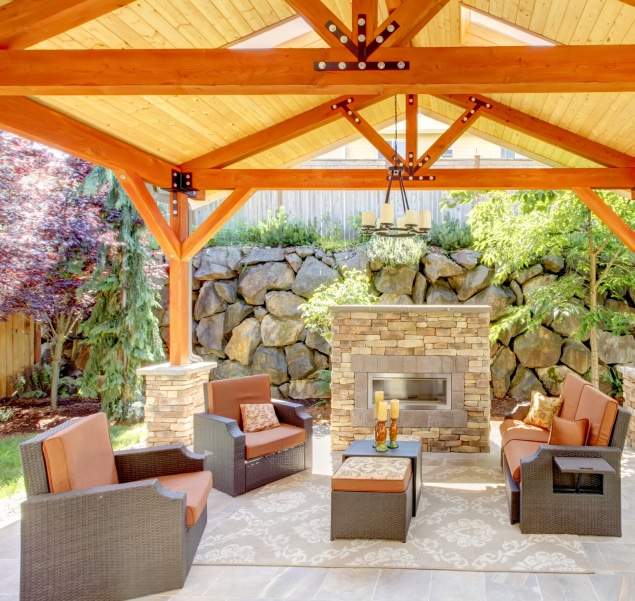
Sometimes nothing is broken. The patio is simply too hot, too exposed or too small for the way you want to live. If you avoid it on summer afternoons, shade may be the upgrade that makes the biggest difference, whether that is a patio cover, a pergola or a screen room. If you want to cook and eat outside, an outdoor kitchen may change how often the space gets used.
A repair fixes a specific problem and leaves the layout alone. A remodel changes the surface, the size, the layout or the features. A few questions help sort out which one you need:
If your answers point to widespread or recurring problems, or to a new use for the space, it is worth pricing a remodel alongside a repair so you can compare them. For the value side of the decision, see our post on patio upgrades and home resale value.
Whether a patio remodel needs a permit depends on the work and your address. The City of New Orleans’ guide to building permits lists paving of a yard, when it complies with the Comprehensive Zoning Ordinance, among work that does not require a building permit, unless the Director determines the work involves hazardous or complex conditions. The same guide says roofs over otherwise unenclosed porches, along with their framing, are not exempt from permitting, and that uncovered residential decks are exempt only within set limits on size, height and attachment to the house. If a remodel adds a gas line for a grill or heater, the guide says those permits must be applied for by the appropriate City-licensed contractor.
The guide also notes that work exempt from a building permit may still need approval from the Vieux Carré Commission or the Historic District Landmarks Commission, and asks owners in a local historic district to contact the appropriate agency before work begins. The HDLC regulates local historic districts and landmarks outside the French Quarter, which has its own Vieux Carré Commission. If your home is in Metairie, Kenner, the Northshore or elsewhere outside New Orleans, check with your city or parish permit office, and ask your contractor who will apply for any required permits.
TurnKey Patio designs and builds custom patios, patio paving and decks for homeowners in New Orleans and our surrounding service areas, including Metairie and Harahan. We benefit if you hire us, and the signs and planning steps above are useful no matter who does the work. To talk through a remodel, call (504) 285-2824, Monday through Friday from 8:00 AM to 3:00 PM, or request a free estimate.
Look at how widespread and how recurring the problems are. A single cracked section or a few loose pavers may be a repair. Settling across the patio, drainage that needs regrading, repeated repairs or a new use for the space point toward a remodel. Pricing both options helps you compare.
Not always. The National Ready Mixed Concrete Association says all concrete has a tendency to crack and that most random cracks appearing at an early age rarely affect structural integrity or service life. Cracks that keep widening, or slabs that tilt or sink, are worth having assessed, especially in the New Orleans area, where the City notes the entire region is subject to subsidence.
It depends on the work. The City of New Orleans guide to building permits lists paving of a yard that complies with the Comprehensive Zoning Ordinance among work that does not require a building permit, unless the Director determines it involves hazardous or complex conditions. Roofs over otherwise unenclosed porches are not exempt, and exempt work may still need HDLC or Vieux Carré Commission approval in a local historic district. Outside New Orleans, check with your city or parish permit office.
The North American Deck and Railing Association’s checklist points to the ledger board, where the deck attaches to the house, as a common source of deck failure. It also suggests checking for soft or decaying wood, loose or corroded fasteners, and railings that are not secure. NADRA notes the checklist is meant to assist homeowners and recommends a professional deck evaluation.
Timing depends on your schedule and the weather. The Atlantic hurricane season runs from June 1 to November 30, according to Ready.gov, so if your project falls in those months, ask how the contractor will protect an unfinished site before a storm. Design and any permits take time, so starting the planning early helps.

 Turnkey Patio