Residential License # 890459
Commercial License # 3667
Claim Your FREE Estimates Today!
Talk to an Expert
Residential License # 890459
Commercial License # 3667
Talk to an Expert

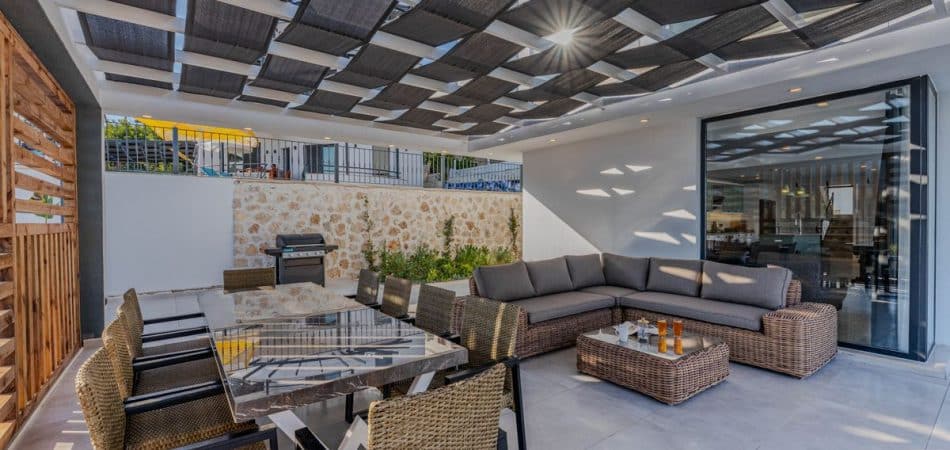
A bioclimatic pergola is an outdoor roof made of adjustable panels, often called louvers, that tilt to let in sun and air or close to give you cover. On motorized systems you change the angle with a button or remote, and optional sensors can respond to wind or sun. For a New Orleans area patio, that means one structure you can adjust for a hot afternoon, a passing shower or a breezy evening. This guide explains the parts, how they work together and what to ask before you buy.

Sun and shade. Tilting the louvers changes how much direct sun reaches the space below. Rising says the rotating panels are designed to let you experience both the brightness of daylight and fresh air. On a summer afternoon you can angle them against the sun, then open them again in the evening.
Airflow. Partly open louvers allow airflow through the roof opening, unlike a typical unvented solid patio cover. On a humid day that can make the space feel less closed in while you still keep direct sun off your seating.

Rain. Closing the louvers turns the roof into cover, and the water carrier profiles in the frame are there to channel the runoff. How a specific system handles a heavy downpour depends on the model and the installation, so ask the installer how the closed roof drains, where the water exits and how to keep the drainage clear. For a side-by-side look at open-slat designs, see our post on bioclimatic vs. traditional pergolas in New Orleans.
Sensors let the roof react when you are away. Rising says the Somfy wind sensor offered with the B Cube line helps keep the product from being damaged by automatically turning it off when a strong wind comes up, and that the opening and closing settings of the combined wind and sun sensor can be adjusted. Somfy’s own sensor lineup for patio products includes wind sensors, sun sensors and a rain and sun sensor, and we offer Somfy motorization for outdoor shade products.
Sensors are a convenience, and storm preparation is still up to you. What a louvered roof should do in high winds is set by its manufacturer, so follow those instructions during storm season. Ready.gov advises bringing in outside furniture and clearing drains and gutters before a hurricane, and the Atlantic hurricane season runs from June 1 to November 30. For more on keeping any pergola in good shape, see how to make a pergola stand up to New Orleans weather.
A bioclimatic pergola can make an existing patio more usable. Common spots include a patio off the kitchen or living room, a dining area, a seating area by a pool, or over an outdoor kitchen. Before you choose a spot, watch where the afternoon sun lands and where rain runs off your roof today. If the structure sits next to the house, plan how its drainage will work with your existing gutters, and confirm the power or fuel requirements for any lights, heaters or motorized screens.
Requirements depend on the structure and your address. In New Orleans, the City’s accessory structure permit page lists gazebos and picnic pavilions among its examples of accessory structures and notes that plan review may include approvals from the Historic District Landmarks Commission or the Vieux Carré Commission, depending on the project. Outside New Orleans, check with your city or parish permit office, and ask your installer who will apply for any required permits.
TurnKey Patio offers bioclimatic pergola systems, including the B-Cube Space and B-Cube Classic, for homeowners in New Orleans and our surrounding service areas. If you are still comparing styles, browse our pergola options. We benefit if you hire us, and the questions above are worth asking any installer. To see which system fits your patio, call (504) 285-2824, Monday through Friday from 8:00 AM to 3:00 PM, or request a free estimate.
A traditional pergola generally has fixed overhead slats or beams instead of adjustable louvers. A bioclimatic pergola has roof panels, or louvers, that rotate so you can adjust sun and airflow and close the roof for cover. Our post comparing bioclimatic and traditional pergolas for New Orleans covers the differences in more detail.
It depends on the model. Rising says the solar shading panels on its B Cube Space rotate up to 90 degrees, and that the B Cube Classic panels can reach 80 degrees of inclination and rotate while retracting. Check the specifications for the exact model you are considering.
The B Cube line can be paired with sensors. Rising says the Somfy wind sensor offered for it turns the product off automatically when a strong wind comes up, to help prevent damage. Sensors do not replace storm preparation, so follow the manufacturer’s instructions for high winds and hurricane season.
Closing the louvers gives you cover from rain, and the frame is designed to channel the runoff. Rising describes water carrier groove profiles on all four sides of the B Cube Classic. How well a specific system handles a heavy downpour depends on the model and installation, so ask the installer how the closed roof drains.
It depends on the project and your address. The City of New Orleans lists gazebos and picnic pavilions among its examples of accessory structures and notes that plan review may include approvals from the HDLC or Vieux Carré Commission. Outside New Orleans, check with your city or parish permit office.
 Turnkey Patio